Skip to content
Slovenia — a landscape evoking the country, painted illustration
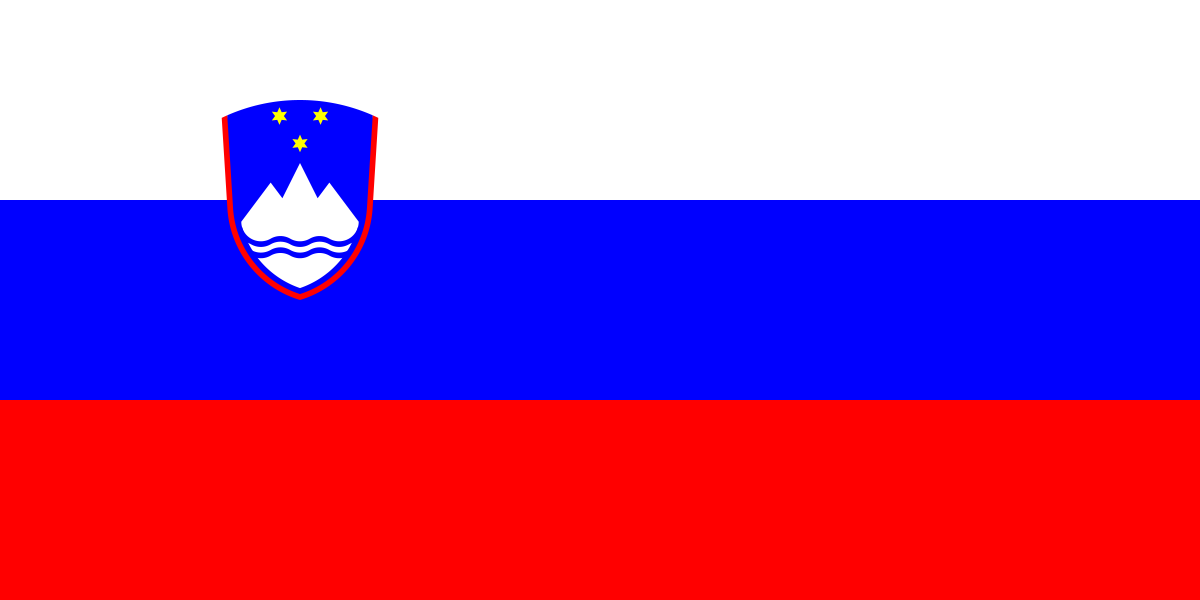
Flag of Slovenia

Central Europe

在Slovenia退休

Slovenia offers a temperate Central European setting with reliable healthcare and a cost of living roughly 40% below the United States. Its compact size, EU membership, and strong life expectancy make it an accessible choice for retirees seeking stability without the heat of southern Europe.

货币
EUR
主要语言
Slovene
人口
2M

一览表

生活成本

比美国便宜约40%

国家物价水平与美国相比 · World Bank (PPP ÷ FX rate), 2025

收入(人均GDP,购买力平价)

$57,186

World Bank, 2024

医疗(全民健保指数)

84/100

全民健康覆盖服务指数 · WHO GHO, 2023

预期寿命

82.3 yrs

World Bank, 2024

生活成本

Slovenia costs noticeably cheaper than the US overall—about 60% of US price levels—which means your retirement income stretches further here. Housing tends to be your largest expense and varies significantly by location: Ljubljana commands higher rents, while smaller towns and the coast offer more affordable options. Groceries, utilities, and local transport are all meaningfully cheaper than the US. Dining out remains affordable, especially outside the capital. Healthcare costs are low, particularly if you use the public system.

Housing (rent or property) is noticeably cheaper than the US, especially outside Ljubljana; expect significant savings if you rent a modest apartment in a smaller city or town. Groceries are markedly cheaper—fresh produce, local dairy, and bread cost considerably less than US prices. Dining out remains affordable, particularly in casual restaurants and away from tourist zones; fine dining in Ljubljana is pricier but still reasonable by US standards. Transport (buses, trains, taxis) is inexpensive; car ownership costs less to maintain than in the US, though fuel prices are moderate. Utilities (heating, electricity, water) run lower than typical US costs. Healthcare expenses are low, especially through the public system; private insurance premiums are modest. Leisure activities—cinema, museums, cultural events—are affordable. Overall, daily life is noticeably cheaper than the US across nearly all categories, though imported goods and some luxury items may cost more.

以国家价格水平(比美国便宜约40%)为基准 — World Bank (PPP ÷ FX rate) 2025。

医疗

Slovenia has a well-established public healthcare system covering residents and retirees, with a strong healthcare coverage index of 84 and life expectancy of 82.3 years. Both EU citizens and residents can access public care; non-EU retirees typically need to obtain resident status first. Most expat retirees combine public care with private insurance or out-of-pocket private visits to avoid public waiting lists and find English-speaking providers. Prescription medications are affordable and widely available.

As a foreign retiree in Slovenia, you can access public healthcare once you obtain resident status and register with a general practitioner. The public system provides comprehensive coverage with minimal out-of-pocket costs for visits, hospitalization, and emergency care, supported by the high healthcare coverage index of 84. Many retirees also purchase private health insurance to supplement public care, which speeds access to specialists and allows choice of provider—private insurance is affordable and widely available. Finding English-speaking doctors is easiest in Ljubljana and larger towns; expat communities often share recommendations. Prescription medications are inexpensive and readily available at pharmacies. Public healthcare can involve wait times for non-urgent specialist appointments, which is why many retirees blend public and private use—perhaps using public care for routine needs and purchasing private visits for faster specialist access. Life expectancy of 82.3 years reflects Slovenia's effective healthcare system. Dental and vision care are often out-of-pocket or partially covered by private insurance.

覆盖指数 84/100 (WHO 2023) · 预期寿命 82.3 年 (World Bank 2024). 一般信息,非医学建议。

成本健康气候长寿繁荣

五因素概况

每个轴是一个 0–100 分数,源自上述指标和下述气候常态 — 没有手动设置。参见方法论了解确切公式。

  • 可负担性60
  • 医疗84
  • 气候舒适度39
  • 长寿89
  • 繁荣79

气候与季节

Slovenia has a temperate continental climate with distinct seasons and moderate rainfall year-round. In Ljubljana, winters are cool—January averages −1.2°C with occasional snow—while summers are pleasantly warm, with July around 19.9°C and annual rainfall at 1051mm. Maribor, in the northeast, is slightly warmer overall (annual mean 9.9°C) with July reaching 21.3°C and somewhat drier at 934mm annually. Koper, on the Adriatic coast, is distinctly milder: January sits around 3.5°C, July hits 23.3°C, and it feels more Mediterranean. Spring (April–May) and autumn (September–October) are crisp and pleasant; summers are warm but rarely scorching; winters bring some snow inland but are generally manageable for those accustomed to temperate climates.

城市年平均值一月七月年降雨量
Ljubljana9.4°C-1.2°C19.9°C1,051 mm
Maribor9.9°C-1.5°C21.3°C934 mm
Koper13.1°C3.5°C23.3°C1,026 mm

Source: NASA POWER (MERRA-2 climatology), long-term climatology.

一年的生活

January and February in Ljubljana bring cold, crisp weather (January mean −1.2°C) with occasional snow inland; heating bills rise, and outdoor activity shifts to indoor pursuits and shorter walks. March through May is a beautiful shoulder season—spring arrives gradually with warming temperatures and blooming gardens; rainfall increases but days grow longer and warmer, making it ideal for exploring and settling into your rhythm. June through August are the warmest months (July average 19.9°C in Ljubljana, 23.3°C in coastal Koper), with long daylight and generally pleasant conditions—ideal for travel, hiking, and outdoor dining, though some July heat can feel muggy inland. September and October repeat the spring appeal in reverse: cooling temperatures, crisp air, and the wine harvest season draw many retirees outdoors; rainfall picks up but it's rarely harsh. November and December grow colder and grayer with increasing indoor gatherings, holiday markets in Ljubljana, and the build-up to winter. Maribor (July 21.3°C) and Koper (milder year-round, January 3.5°C, July 23.3°C) offer slightly warmer alternatives. Many retirees use summer for travel within Europe and autumn for returning to Slovenia; winter is a quieter, more introspective season of local community and indoor cultural life.

城市深度解析

Ljubljana, the capital, is a compact, bike-friendly city of charm and walkability, with a lively old town, good cultural institutions, and the largest expat network—suited to those wanting modest urban life and ease of access to services. Maribor, in the northeast, is a quieter, smaller city with a strong wine-growing region nearby and a more local, less touristed feel—good for retirees seeking peace and a slower pace. Koper, on the Adriatic coast, offers the mildest climate and Mediterranean flavor, with access to beaches and a more international vibe; it's livelier and sunnier than inland cities but less cosmopolitan than Ljubljana.

退休签证途径

无专门退休签证

The main pathway for retirees is the D visa for residence, available to non-EU/EEA citizens who can demonstrate financial self-sufficiency—typically around a modest monthly income threshold, though you should verify the current requirement with your nearest embassy. EU/EEA citizens enjoy freedom of movement and residence under EU rules. The process begins with gathering proof of income (pension statements, savings), health insurance documentation, and a clean police record, then applying at the Slovenian embassy or consulate in your home country. After approval, you receive an entry visa valid for the initial stay, which you then convert to a residence permit at the local administrative office in Slovenia. Residence permits are typically renewable annually, with a path toward permanent residence after continuous legal residence. Check the official Slovenian government immigration portal and contact your nearest Slovenian embassy or consulate for current thresholds and document requirements.

逐步说明

1. Gather documentation: obtain recent bank statements or pension letters demonstrating financial self-sufficiency (around the current threshold—verify with your embassy), a health insurance policy, a police clearance from your home country, and a medical certificate of good health. 2. Contact your nearest Slovenian embassy or consulate and submit your D-visa application along with a completed application form and passport. 3. Attend a visa interview if required and provide biometrics. 4. Receive your entry visa (typically valid for several months). 5. Travel to Slovenia and register with the local administrative office in your municipality of residence within the prescribed timeframe. 6. Convert your entry visa to a residence permit (often called a 'residence document') by submitting your visa and proof of accommodation and income to the local office. 7. Receive your residence permit, valid for one year initially. 8. Renew your permit annually by submitting updated proof of income and residence before expiration; after a set number of years of continuous legal residence, you may apply for permanent residence. Consult the official Slovenian government immigration portal for current thresholds, document lists, and timelines, and contact your nearest embassy or consulate for guidance specific to your citizenship and circumstances.

已验证的官方来源: www.policija.si

由官方资源草拟的AI内容 · 待人工审核 · 草拟于 2026-07

税务

Slovenia taxes residents on worldwide income, but retirees from outside the EU/EEA may benefit from tax treaties depending on their home country—pensions and investment income are often treated favorably. EU/EEA retirees are subject to standard Slovenian income tax on Slovenian-source income, though many receive tax relief on foreign pensions under bilateral agreements. The country has no wealth tax or inheritance tax for direct heirs, which can be advantageous for retirees. Tax residency depends on physical presence and intent; the rules are complex and vary by individual circumstance and home-country treaty. You should consult a cross-border tax professional before retiring to understand your specific obligations.

安全与旅游警告

Slovenia is a safe country with low violent crime rates and a stable political environment, making it comfortable for older residents. Petty theft in cities exists but is not rampant; standard urban precautions apply. Healthcare infrastructure is reliable, and emergency services respond promptly. Winters can bring icy roads inland, so caution is warranted if driving in snowy months. Consult your home government's official travel advisory for the current safety and health picture.

在这里退休是什么样的

Daily life in Slovenia moves at a measured pace—less hectic than major Western cities but with modern amenities and good infrastructure. The culture values outdoor activity and nature; hiking, cycling, and farmers' markets are woven into the rhythm. Expat communities exist, particularly in Ljubljana, but are smaller than in some other European retirement hubs, meaning you'll need language basics or a willingness to learn Slovene for deeper integration. Public transport is efficient and affordable; many retirees find they don't need a car. The population is English-friendly, especially among younger people and in cities. Social life revolves around community events, cultural offerings, and nature outings rather than nightlife.

通常适合: Retirees comfortable with cool winters, wanting walkable towns and cultural access over beach life, and able to navigate bureaucracy in a small, relatively affluent EU state.

常见问题

在Slovenia退休要花多少钱?
Slovenia的总体生活成本为比美国便宜约40%(World Bank PPP购买力平价水平)。 Slovenia costs noticeably cheaper than the US overall—about 60% of US price levels—which means your retirement income stretches further here. Housing tends to be your largest expense and varies significantly by location: Ljubljana commands higher rents, while smaller towns and the coast offer more affordable options.
Slovenia的医疗保健如何?
Slovenia在WHO全民医疗保障指数上得分为84/100。 Slovenia has a well-established public healthcare system covering residents and retirees, with a strong healthcare coverage index of 84 and life expectancy of 82.3 years. Both EU citizens and residents can access public care; non-EU retirees typically need to obtain resident status first.
Slovenia的气候如何?
Slovenia全年平均气温为9.4°C,范围从-1.2°C到19.9°C(NASA POWER常年数据)。 Slovenia has a temperate continental climate with distinct seasons and moderate rainfall year-round. In Ljubljana, winters are cool—January averages −1.2°C with occasional snow—while summers are pleasantly warm, with July around 19.9°C and annual rainfall at 1051mm.
Slovenia提供什么退休或长期居留签证?
Slovenia does not have a dedicated retirement visa. Long-stay residence typically requires either employment, family ties, or documented financial self-sufficiency; the exact threshold and income verification process vary by your circumstances and consulate. You should verify current requirements and permitted pathways (such as freelancer registration or investor status) with the Slovenian Immigration and Border Police administration or your nearest consulate, as rules change and individual cases differ.
Slovenia对退休人士安全吗?
Check your government's official travel advisory for Slovenia before making a move.
如果我在Slovenia退休,我需要缴税吗?
Consult a tax professional qualified in both your home country and Slovenia, as non-resident retirees face distinct obligations and may qualify for certain exemptions or credits.
本概况是研究辅助工具,不构成移民、税务或财务建议。数据为国家级别,附带来源和年份;签证和生活方式摘要由AI从官方页面草拟,待人工审核。在采取行动前,请务必核实官方政府来源和具有资质的专业人士的信息。