Skip to content
Singapore — a landscape evoking the country, painted illustration
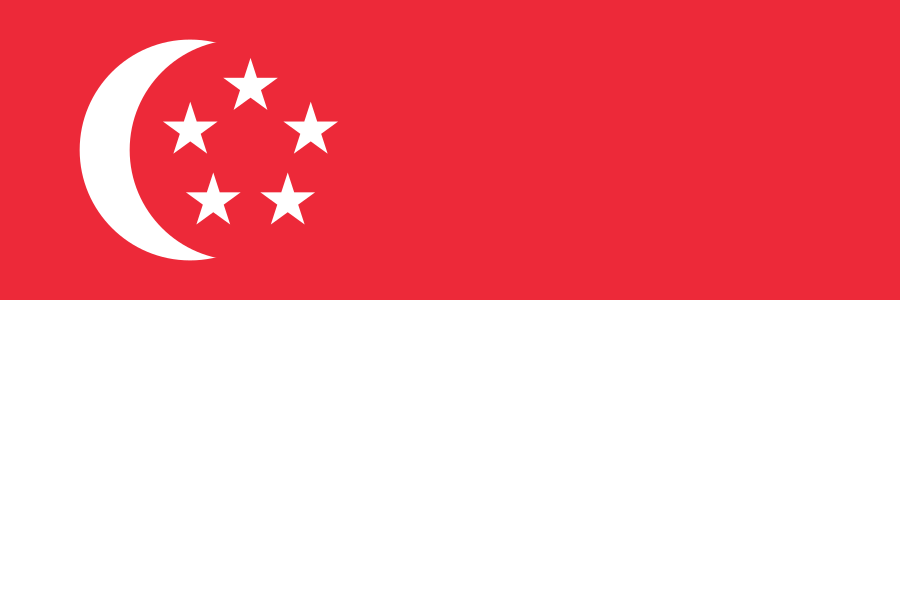
Flag of Singapore

Southeast Asia

在Singapore退休

Singapore offers one of the world's highest life expectancies and robust healthcare, along with a stable, English-speaking environment and efficient infrastructure. The tropical climate is consistently warm year-round, and living costs are moderate relative to the developed-world services and safety you'll find. It's a compact, orderly city-state where retirees can access world-class medicine and financial services.

货币
SGD
主要语言
English
人口
6M

一览表

生活成本

比美国便宜约40%

国家物价水平与美国相比 · World Bank (PPP ÷ FX rate), 2025

收入(人均GDP,购买力平价)

$150,689

World Bank, 2024

医疗(全民健保指数)

88/100

全民健康覆盖服务指数 · WHO GHO, 2023

预期寿命

83.3 yrs

World Bank, 2024

生活成本

Singapore's cost of living is noticeably cheaper than the US—about 40% lower overall when measured by purchasing power. Your money stretches furthest on groceries and local food, especially if you eat at hawker centers and local restaurants. Housing (whether renting or buying) tends to be the largest expense, along with utilities and transport. Private healthcare and dining at upmarket establishments will cost more, but everyday essentials and public transport are genuinely affordable.

Housing (rent or purchase) is a major expense and often the single biggest line item; it's cheaper than major US cities but not inexpensive. Groceries and hawker-center meals are noticeably cheaper, making food one of the few categories where retirees feel a strong savings. Dining at restaurants and cafes is moderate—cheaper than US fine dining but pricier than street food. Transport (MRT, buses, taxis) is affordable and efficient; car ownership is expensive due to import duties and tolls, so most retirees rely on public transit or ride-sharing. Utilities (electricity, water, internet) are reasonable. Healthcare costs vary widely: public-system use is cheap if you're eligible, private consultations and insurance premiums are moderate compared to the US, and medications are cheaper. Leisure activities (museums, parks, cultural events) are inexpensive; golf, country clubs, and premium hobbies cost more. Overall, a retiree on a modest US pension can live comfortably, though housing will consume a significant share of the budget.

以国家价格水平(比美国便宜约40%)为基准 — World Bank (PPP ÷ FX rate) 2025。

医疗

Singapore has a strong hybrid healthcare system with a coverage index of 88, reflecting excellent overall access. Life expectancy of 83.3 years is among the world's highest. Residents typically combine public (subsidized) and private care: the public system is efficient and affordable, while private insurance is common and often employer-sponsored or purchased individually. Many foreign retirees opt for private insurance to ensure English-speaking doctors and shorter wait times. The system is modern, well-regulated, and oriented toward preventing disease and managing chronic conditions.

Foreign retirees in Singapore can access both public and private healthcare. The public system (Ministry of Health clinics and hospitals) is subsidized and open to residents, but eligibility and subsidy levels vary by visa type—some visa holders receive reduced subsidies or none. Most foreign retirees buy private insurance (international or local) to ensure seamless access to English-speaking private practitioners, shorter wait times, and coverage for chronic conditions without bureaucratic friction. Finding an English-speaking doctor is not difficult: Singapore's medical professionals are widely trained in English, and the private sector caters to expatriates. Prescription medications are readily available at pharmacies; costs are lower than the US. Public hospital wait times for non-emergency care can stretch weeks, while private clinics typically offer same-day or next-day appointments. Many retirees adopt a pragmatic mix: routine care or emergencies at public hospitals (if eligible) and private insurance for ongoing or elective care. Dental, vision, and preventive care are not heavily subsidized and are usually handled privately. Register with a private clinic or buy a comprehensive international health insurance plan early—it will ease access and reduce stress.

覆盖指数 88/100 (WHO 2023) · 预期寿命 83.3 年 (World Bank 2024). 一般信息,非医学建议。

成本健康气候长寿繁荣

五因素概况

每个轴是一个 0–100 分数,源自上述指标和下述气候常态 — 没有手动设置。参见方法论了解确切公式。

  • 可负担性60
  • 医疗88
  • 气候舒适度74
  • 长寿92
  • 繁荣99

气候与季节

Singapore is tropical year-round with no true winter or summer—temperatures stay warm and consistent across all three cities (Singapore, Jurong, Woodlands). January averages 25.9°C, while July averages 27.1°C, so the annual mean of 27.1°C is reliable; you'll never face cold. The defining feature is humidity and rain: annual precipitation of 2368 mm falls fairly evenly throughout the year, with heavier monsoon bursts from November to March (northeast monsoon) and June to September (southwest monsoon). Expect warm, humid days almost daily; the distinction between seasons is wet and less wet, not hot and cold. Air-conditioned interiors are the norm, and sudden afternoon thunderstorms are routine.

城市年平均值一月七月年降雨量
Singapore27.1°C25.9°C27.1°C2,368 mm
Jurong27.1°C25.9°C27.1°C2,368 mm
Woodlands27.1°C25.9°C27.1°C2,368 mm

Source: NASA POWER (MERRA-2 climatology), long-term climatology.

一年的生活

January brings slightly cooler weather (25.9°C) and the northeast monsoon, with heavier rain and a festive atmosphere around Chinese New Year celebrations; it feels refreshing compared to other months. February to May are warm and humid with occasional rain; March sees Hari Raya festivities. June to August remain hot (around 27.1°C) with the southwest monsoon bringing afternoon thunderstorms; many retirees take this as 'shoulder season' to travel or spend more time indoors in air conditioning. September to October can see regional haze and heavier monsoon rain; it's the most humid stretch and less pleasant for outdoor activity. November to December cool slightly and dry out slightly, marking the start of the tourist season and Chinese New Year preparations; December brings Christmas celebrations and year-end festivities. Throughout the year, the rhythm is fairly consistent: warm mornings, hot midday (best spent indoors or by the pool), afternoon thunderstorms, cooler evenings. Monsoon seasons (Nov–Mar, Jun–Sep) bring heavier rain and higher humidity; shoulder months (May, Oct) offer slightly more pleasant conditions. Most retirees shift their outdoor activities to early morning or late afternoon, embrace indoor cultural and social activities, and take regional trips during the drier shoulder periods.

城市深度解析

Singapore itself—the heart of the city-state—is dense, ultra-modern, and walkable, with gleaming towers, manicured public spaces, and a bustling Central Business District; it suits active retirees who enjoy urban energy and cosmopolitan amenities. Jurong, in the west, is residential and more spacious, popular with families and retirees seeking quieter neighborhoods while remaining connected by MRT; it feels suburban compared to the core. Woodlands, in the north near the Malaysian border, is similarly residential and quieter, attracting those who want an even more relaxed, neighborhood feel with good local amenities and easier access to Malaysia. All three share the same tropical climate and excellent infrastructure; your choice depends on whether you prefer urban buzz or residential calm.

退休签证途径

Long Term Visit Pass (LTVP) / Permanent Residence (case-by-case)投资

Singapore has visa pathways available for retirees, though final approval rests with immigration authorities and is not guaranteed. The Long-Term Visit Pass (LTVP) is a common option for those without local employment. LTVP applications typically involve proof of substantial financial means (around SGD 500,000 or annual income figures—verify the current threshold with the Immigration & Checkpoints Authority) and a demonstration that you can support yourself without working, but meeting these criteria does not guarantee approval. Other retirees may pursue the Dependant's Pass if eligible, or employment-based visas or the Tech.Pass/EntrePass if entrepreneurial. The process involves applying through the ICA, providing documentation of income and assets, undergoing a police and health check, and receiving approval before entry. Timeline is typically several weeks to a few months. Consult the official Immigration & Checkpoints Authority website and your nearest Singapore embassy or consulate for current requirements and application procedures—the rules and thresholds change periodically.

逐步说明

1. Gather proof of financial means (typically around SGD 500,000 in savings or annual income figures—verify the current threshold with the Immigration & Checkpoints Authority). 2. Prepare supporting documents: passport copies, recent bank statements, proof of income or pension, curriculum vitae, and potentially a police clearance from your home country. 3. Contact the Singapore Immigration & Checkpoints Authority or apply through your nearest Singapore embassy or consulate to inquire about the appropriate visa category (Long-Term Visit Pass, Dependant's Pass, or other retirement options). 4. Submit your application with all required documentation and fees. 5. Undergo a medical examination and police background check (the authority will specify which). 6. Receive your entry visa approval and travel to Singapore. 7. Upon arrival, complete any in-country registration or conversion to a residence permit as instructed. 8. Plan to renew your pass according to the validity period (typically 1–2 years) and follow the renewal timeline toward long-term or permanent residence eligibility if desired. Consult the official Immigration & Checkpoints Authority website and your nearest Singapore embassy or consulate for the most current requirements and timelines—visa policies and financial thresholds change periodically.

已验证的官方来源: www.ica.gov.sg

由官方资源草拟的AI内容 · 待人工审核 · 草拟于 2026-07

税务

Singapore taxes residents on worldwide income, but retirees and foreign investors often benefit from its favorable tax treaties and the absence of capital gains tax, dividend tax, or inheritance tax. Foreign-sourced income may be exempt if not remitted to Singapore (the 'remittance basis'), which can be advantageous if you're drawing from overseas pensions or investments. However, tax treatment varies significantly depending on your residence status, citizenship, visa type, and home country—especially regarding tax treaties. You'll want to work with a cross-border tax professional early to understand your obligations in both Singapore and your home country, and to ensure compliance with foreign income disclosure rules.

安全与旅游警告

Singapore is one of the world's safest cities with low violent crime, good street lighting, efficient policing, and a general sense of security. Petty theft and scams do occur, as in any city, so normal precautions apply: don't flash valuables, be cautious with cash and cards, and stay aware in crowded areas. Healthcare is clean and reliable, food safety is rigorously regulated, and tap water is safe. Air quality can vary, especially during the regional haze season (September–October); check your home government's travel advisory for the current overall safety picture and any health warnings.

在这里退休是什么样的

Retired life in Singapore moves at a deliberate, organized pace. The city-state is highly walkable, efficient, and compact—you can access most services by MRT (metro), bus, or short taxi ride. English is the main business and everyday language, so communication is straightforward for English speakers. There's a visible and welcoming expat community, including many retirees; you'll find international clubs, hobby groups, and social networks. The rhythm is cosmopolitan but orderly: hawker centers buzz at lunch and dinner, parks and gardens are popular for morning walks, and cultural events (Chinese New Year, Hari Raya, Deepavali, Christmas) dot the calendar. Medical and professional services are world-class and English-fluent. The tropical heat and humidity require adjustment—most retirees embrace air-conditioned shopping malls, indoor recreation, and a slower midday pace.

通常适合: Retirees who value excellent healthcare, English-language ease, low crime, and don't mind warm, humid weather—and who have substantial savings or pension income to meet Singapore's cost of living.

常见问题

在Singapore退休要花多少钱?
Singapore的总体生活成本为比美国便宜约40%(World Bank PPP购买力平价水平)。 Singapore's cost of living is noticeably cheaper than the US—about 40% lower overall when measured by purchasing power. Your money stretches furthest on groceries and local food, especially if you eat at hawker centers and local restaurants.
Singapore的医疗保健如何?
Singapore在WHO全民医疗保障指数上得分为88/100。 Singapore has a strong hybrid healthcare system with a coverage index of 88, reflecting excellent overall access. Life expectancy of 83.3 years is among the world's highest.
Singapore的气候如何?
Singapore全年平均气温为27.1°C,范围从25.9°C到28.1°C(NASA POWER常年数据)。 Singapore is tropical year-round with no true winter or summer—temperatures stay warm and consistent across all three cities (Singapore, Jurong, Woodlands). January averages 25.9°C, while July averages 27.1°C, so the annual mean of 27.1°C is reliable; you'll never face cold.
Singapore提供什么退休或长期居留签证?
Singapore does not offer a dedicated retirement visa. Long-stay options include the Long Term Visit Pass (LTVP) for those with financial means and family sponsorship, or the Dependant's Pass if you're a dependent of a Singapore citizen or resident. Some retirees enter on a Visit Pass and apply for permanent residence if they meet investment or employment criteria.
Singapore对退休人士安全吗?
Check your government's official travel advisory for Singapore before deciding to retire there.
如果我在Singapore退休,我需要缴税吗?
Singapore residents may be liable for income tax on Singapore-sourced income and foreign income remitted into Singapore; consult a tax professional or the Inland Revenue Authority to understand your personal obligations.
本概况是研究辅助工具,不构成移民、税务或财务建议。数据为国家级别,附带来源和年份;签证和生活方式摘要由AI从官方页面草拟,待人工审核。在采取行动前,请务必核实官方政府来源和具有资质的专业人士的信息。