
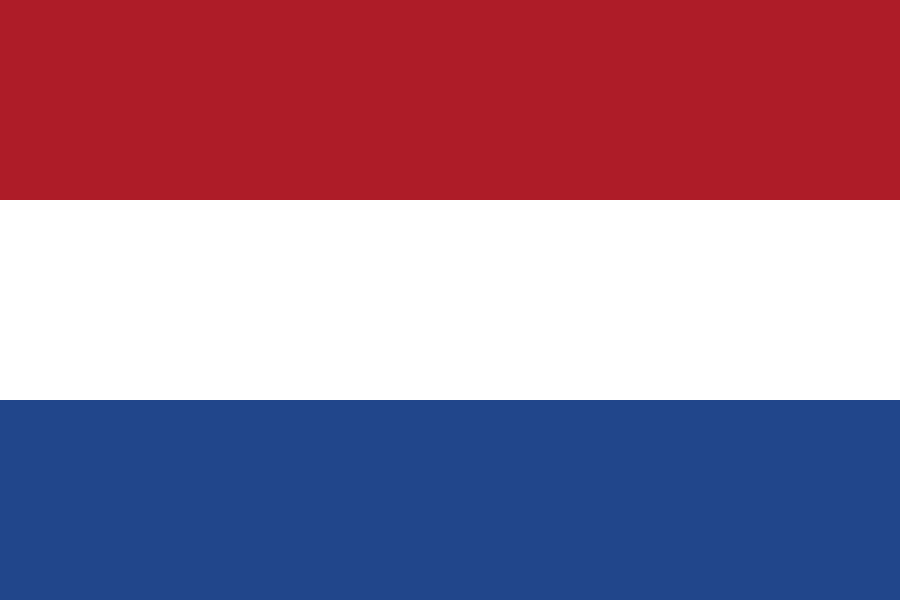
Western Europe
Im Ruhestand in Netherlands
The Netherlands offers Western Europe's hallmark stability: universal healthcare, excellent infrastructure, and a temperate climate with mild winters. Life expectancy is among the world's highest, and the cost of living, while not cheap, is reasonable for the region. It's a place built for order and cycling, where English is widely spoken and bureaucracy, though thorough, is predictable.
- Währung
- EUR
- Hauptsprache
- Dutch
- Bevölkerung
- 18M
Auf einen Blick
Lebenshaltungskosten
~19% günstiger als in den USA
nationales Preisniveau im Vergleich zu den USA · World Bank (PPP ÷ FX rate), 2025
Wie sich die Zahlen entwickelt haben
The Netherlands has experienced steady economic and health improvement over the past 15 years. GDP per capita (PPP) has grown from 45,301 international dollars in 2010 to 86,174 in 2024, reflecting sustained prosperity and rising living standards. Life expectancy has climbed from 80.7 years in 2010 to 82 years in 2024, with only minor fluctuations (a dip to 81.3 in 2021, likely COVID-related, recovering by 2022). Population has grown steadily from around 16.69 million in 2011 to 18.09 million in 2025, indicating both natural growth and immigration. For a retiree, these trends are highly encouraging: the country's wealth and healthcare outcomes have strengthened consistently, public services remain well-funded, and the economic foundation supports the social safety net you'll rely on.
Mehrjährige Reihe der Weltbank — die gleichen Indikatoren wie oben, im Zeitverlauf.
Lebenshaltungskosten
The Netherlands has a price level around 81% of American costs, though the advantage is most visible in everyday groceries, dining out, and public transport; housing in popular cities like Amsterdam commands premium prices. Healthcare and utilities tend to feel affordable relative to the US, and childcare and education (if relevant) are subsidized systems. Your euros stretch furthest outside the major cities and in smaller towns across the country.
Housing is the largest expense for retirees, especially in Amsterdam and Rotterdam, where rents and property prices reflect premium urban demand; smaller cities and towns offer noticeably cheaper accommodation. Groceries and local markets are affordable and often cheaper than the US, with excellent seasonal produce and dairy. Dining out is moderate in cost—casual restaurants and cafés are inexpensive, while fine dining carries European urban prices. Public transport (buses, trams, trains) is efficient, frequent, and affordable; owning a car is optional and often unnecessary. Utilities (heating, electricity, water) are moderate and predictable. Healthcare, once you're insured, is noticeably cheaper than the US out-of-pocket; prescription costs are low. Leisure activities—museums, theater, cycling, travel within Europe—range from very affordable (cycling, parks, many museum discounts for seniors) to moderate. Overall, your US retirement dollar stretches comfortably outside central Amsterdam, particularly in utilities, transport, and healthcare.
Verankert am nationalen Preisniveau (~19% günstiger als in den USA) — World Bank (PPP ÷ FX rate) 2025.
Gesundheitswesen
The Netherlands has a universal healthcare system with a coverage index of 85, and life expectancy stands at 82 years—among Europe's highest. Residents are required to carry basic health insurance, and both Dutch citizens and long-term residents typically access care through a mix of the public system and supplementary private insurance. Foreign retirees generally qualify for the public scheme once they establish residence, though many also purchase private coverage for faster specialist access and broader choice of providers. English-speaking doctors are common in cities and larger towns, and prescription medications are readily available through pharmacies.
As a foreign retiree establishing residence, you may be able to join the Dutch compulsory health insurance system once you're registered with the municipality; eligibility and enrollment are assessed by the official authorities. The public system covers basic medical care, hospitalization, prescription drugs, and preventive care; waiting times for non-urgent care are generally short (often days, rarely weeks for routine appointments), though specialist referrals may take longer. Many retirees supplement public insurance with private policies to access a wider choice of doctors and shorter waits for elective procedures. Finding English-speaking GPs is straightforward in cities and larger towns; most have English-speaking staff or can direct you to colleagues who do. Prescriptions are filled at pharmacies without difficulty, and medication availability is excellent. Mental health support and physiotherapy are covered; preventive care (screenings, check-ups) is emphasized. The Dutch system is efficient and evidence-based; retirees generally report high satisfaction with the quality and accessibility of care.
Abdeckungsindex 85/100 (WHO 2023) · Lebenserwartung 82 Jahre (World Bank 2024). Allgemeine Informationen, keine medizinische Beratung.
Das Fünf-Faktoren-Profil
Jede Achse ist eine 0–100-Punktzahl, die sich aus den oben genannten Quellindikatoren und den unten stehenden Klimanormalen ergibt — nichts ist manuell festgelegt. Siehe die Methodik für die genauen Formeln.
- Erschwinglichkeit39
- Gesundheitswesen85
- Klimakomfort53
- Langlebigkeit88
- Wohlstand88
Klima & Jahreszeiten
The Netherlands has cool, damp winters and mild summers across all regions. In Amsterdam, January averages 3.5°C and July reaches 17.9°C; Rotterdam is marginally warmer at 3.8°C in January and 18.1°C in July; Eindhoven experiences colder winters at 2.3°C in January but the warmest summers at 18.8°C in July. Annual rainfall is consistent and moderate—Amsterdam and Rotterdam each receive around 827–835 mm, while Eindhoven is slightly drier at 768 mm. Expect frequent cloud cover, drizzle, and wind year-round; winters are grey and damp rather than snowy, and summers never become hot. Spring (April–May) brings earlier daylight and blooming flowers; autumn (September–October) mirrors spring's mild weather before the dark, wet winter sets in.
| Stadt | Jahresmittelwert | Januar | Juli | Niederschlag / Jahr |
|---|---|---|---|---|
| Amsterdam | 10,5°C | 3,5°C | 17,9°C | 827 mm |
| Rotterdam | 10,8°C | 3,8°C | 18,1°C | 835 mm |
| Eindhoven | 10,4°C | 2,3°C | 18,8°C | 768 mm |
Quelle: NASA POWER (MERRA-2 climatology), long-term climatology.
Ein Jahr im Leben
January through March is the coldest, greyest season: Amsterdam averages 3.5°C in January with frequent drizzle; daylight is short (around 8 hours at winter solstice), and the mood is introspective. Many retirees travel south or embrace indoor cultural life—museums, concerts, and cafés—during these months. April and May are spring's highlight: days lengthen rapidly, temperatures mild (around 10–13°C), flowers bloom, and outdoor cycling and walking return; shoulder season is ideal for exploring. June through August brings peak summer: Rotterdam and Amsterdam reach 18°C, the days are long and bright, and outdoor life dominates—street markets, canal-side dining, and European travel are at their best, though tourism peaks and accommodation fills. September and October mirror spring's mild, pleasant weather (around 13–15°C) and are quieter; autumn colors and harvest festivals punctuate local life. November through December darkens quickly; temperatures drop toward the January average, rain increases, and winter holidays (December markets, family traditions) warm the social calendar before the cycle repeats. Many retirees time winter trips south or to sunnier climates during January–February to break the longest dark stretch.
Die Städte im Detail
Amsterdam is the vibrant, historic capital with canals, museums, and a thriving expat community; it's walkable and lively but crowded and expensive. Rotterdam, the major port city, feels more modern and industrial, with a younger vibe and slightly lower costs than Amsterdam; it's well-connected and less touristy. Eindhoven, in the south, is smaller and quieter with a tech-sector presence and a more intimate, provincial atmosphere—appealing if you prefer calm over buzz. Each is accessible by excellent train and cycling infrastructure; Amsterdam and Rotterdam suit active, socially engaged retirees, while Eindhoven appeals to those seeking a gentler pace and lower cost of living.
Rentnervisum-Weg
The primary route for retirees is the Non-Lucrative Residence Permit (often called the D visa), aimed at people with sufficient independent income or retirement savings. You'll generally need to demonstrate stable, regular income or substantial savings—verify the current threshold with the Dutch immigration authorities—and show proof of health insurance and accommodation. Note that meeting these requirements does not guarantee approval; individual assessment and eligibility decisions rest with the Dutch immigration authorities (IND). The process typically involves applying at the Dutch embassy or consulate in your home country, submitting proof of income/savings, undergoing a background check and medical examination, receiving an entry visa, and then converting it to a residence permit within the Netherlands. Timelines usually span several months from application to entry. Consult the official Dutch government immigration portal and your nearest Dutch embassy or consulate for current requirements and procedures.
Schritt für Schritt
First, gather proof of stable income or sufficient retirement savings (verify the current threshold), obtain a recent police clearance from your home country, and secure comprehensive health insurance recognized in the Netherlands. Second, contact your nearest Dutch embassy or consulate and submit your application for a Non-Lucrative Residence Permit, including proof of income/savings, accommodation details, and insurance documentation. Third, attend a visa interview if required, undergo medical screening (usually straightforward for retirees), and await approval—typically a few weeks to a few months. Fourth, once approved, collect your entry visa from the embassy. Fifth, travel to the Netherlands and register with your local municipality (gemeente) within five days of arrival to convert your entry visa into a residence permit. Finally, maintain your residence permit by renewing it on schedule (usually annually in the first years, then longer intervals toward permanent residence) and ensuring your income/savings and insurance remain valid. Throughout the process, consult the official Dutch government immigration portal and your nearest Dutch consulate for current forms, timelines, and requirements.
Verifizierte offizielle Quelle: www.ind.nl
KI-Entwurf aus offiziellen Quellen · ausstehende Überprüfung durch Mensch · entworfen 2026-07
Steuern
The Netherlands taxes residents on their worldwide income, but offers favorable treatment for certain retirement income and has extensive tax treaties with most countries to avoid double taxation. Foreign retirees may qualify for reduced tax on pension income or investment returns, depending on their residency status and treaty provisions with their home country. Tax residency is determined by having a permanent home available to you in the Netherlands and spending significant time there; obligations vary by your citizenship and income sources. Given the complexity of cross-border tax status, you should engage a specialist in international tax planning who understands both Dutch rules and your home country's tax code before moving.
Sicherheit & Reisewarnungen
The Netherlands is a safe country with low violent crime, well-maintained public spaces, and reliable emergency services. Petty theft and bicycle theft are the most common concerns in cities; standard urban awareness (securing belongings, avoiding isolated areas at night) is sufficient. Healthcare quality is high, water is safe, and public health infrastructure is excellent. For current travel advisories and health concerns, consult your government's official travel advisory for the Netherlands, which will give you up-to-date information on any regional issues or seasonal health alerts.
Wie es sich hier zu leben anfühlt
Life in the Netherlands is orderly, cycling-friendly, and socially progressive. Dutch people value directness and informality, and expat communities—particularly in Amsterdam and Rotterdam—are well-established and welcoming. Daily life revolves around bicycles, public transport, and a strong café culture; you'll find good coffee, cheese markets, and vibrant street life in cities, with quieter village rhythms in the countryside. English is widely spoken, especially among younger people and in urban areas, though learning basic Dutch improves social integration and daily errands. The pace is unhurried compared to many US cities, with a strong emphasis on work–life balance, outdoor recreation (walking, cycling, water sports), and family time. Winters are dark and require intentionality about staying social and active; many retirees travel south during the greyest months or embrace the cozy indoor culture of cafés and museums.
Passt typischerweise zu: Retirees who value walkable cities, reliable public services, cultural access, and a multilingual environment—and who aren't seeking warm winters or low costs.
Häufig gestellte Fragen
- Wie viel kostet es, in Netherlands in den Ruhestand zu gehen?
- Die Gesamtlebenshaltungskosten in Netherlands sind ~19% günstiger als in den USA (World Bank PPP-Preisniveau). The Netherlands has a price level around 81% of American costs, though the advantage is most visible in everyday groceries, dining out, and public transport; housing in popular cities like Amsterdam commands premium prices. Healthcare and utilities tend to feel affordable relative to the US, and childcare and education (if relevant) are subsidized systems.
- Wie ist das Gesundheitswesen in Netherlands?
- Netherlands erreicht 85/100 beim WHO-Index für universelle Gesundheitsversorgung. The Netherlands has a universal healthcare system with a coverage index of 85, and life expectancy stands at 82 years—among Europe's highest. Residents are required to carry basic health insurance, and both Dutch citizens and long-term residents typically access care through a mix of the public system and supplementary private insurance.
- Wie ist das Klima in Netherlands?
- Netherlands hat das ganze Jahr über einen Durchschnitt von 10,5°C, mit einer Spanne von 3,5°C bis 18°C (NASA POWER Normalwerte). The Netherlands has cool, damp winters and mild summers across all regions. In Amsterdam, January averages 3.5°C and July reaches 17.9°C; Rotterdam is marginally warmer at 3.8°C in January and 18.1°C in July; Eindhoven experiences colder winters at 2.3°C in January but the warmest summers at 18.8°C in July.
- Welches Renten- oder Langzeitvisum bietet Netherlands?
- The Netherlands does not offer a dedicated retirement visa program. EU/EEA citizens have freedom of residence; non-EU retirees typically apply for a residence permit under the Family Reunification directive or a residence permit for independent means (which requires proof of stable, regular income and health insurance). The exact income threshold varies; you should verify current requirements and consult the IND (Immigratie- en Naturalisatiedienst) directly, as rules change.
- Ist Netherlands sicher für Rentner?
- Check your government's latest official travel advisory for the Netherlands for current health, security, and consular information.
- Muss ich Steuern zahlen, wenn ich in Netherlands in den Ruhestand gehe?
- The Netherlands taxes worldwide income for residents and has wealth tax implications; consult a tax professional familiar with expatriate and Dutch tax law before committing.
Wo Sie weiter schauen sollten
Mehr in Western Europe

Ähnliche Lebenshaltungskosten